Why Do Businesses Watch Freelancers More Closely Than Employees?
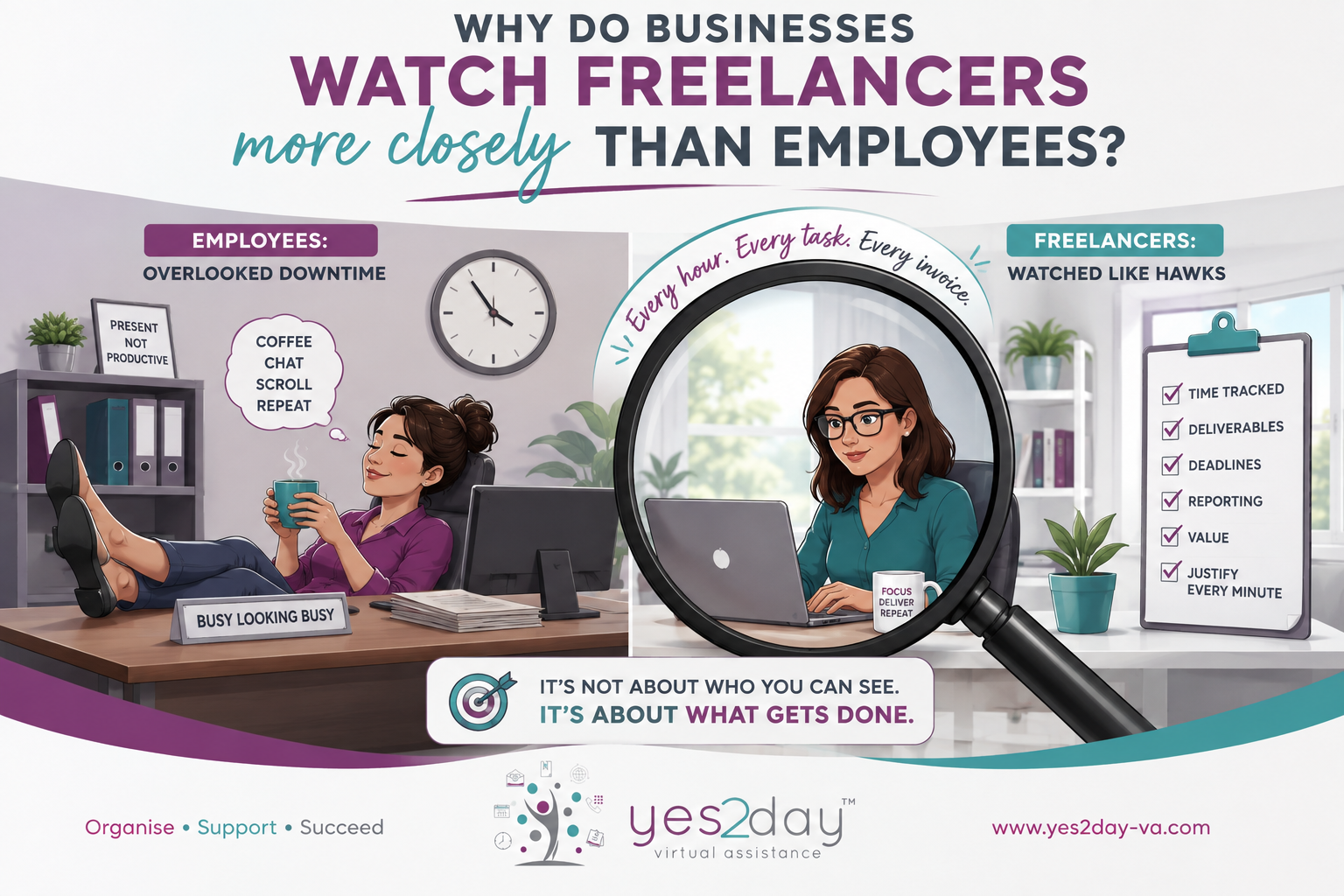
Businesses often scrutinise freelancers more closely than employees because freelancer costs are visible, measurable and directly linked to an invoice. Employee inefficiencies are easier to absorb into monthly payroll costs. This can create a strange double standard where freelancers are measured on results while employees are still largely measured on attendance.
The Question That Got Me Thinking
Why do businesses sometimes overlook unproductive employee behaviour, but watch freelancers like hawks?
Think about it.
An employee can spend 20 minutes making coffee, have a chat with a colleague, sit through an unnecessary meeting or stretch a one-hour task across an entire morning.
It often disappears into the working day.
But let a freelancer invoice for three hours and suddenly we’re asking:
What exactly did they do? Why did it take three hours? Could it have been done in two?
Interesting, isn’t it?
This isn’t an argument against employees or in favour of freelancers. Most businesses have excellent employees, poor employees, excellent freelancers and poor freelancers.
The interesting part is how differently we measure them.
And perhaps the real question isn’t why freelancers are monitored so closely.
Perhaps it’s why we don’t apply the same focus on outcomes to everyone.
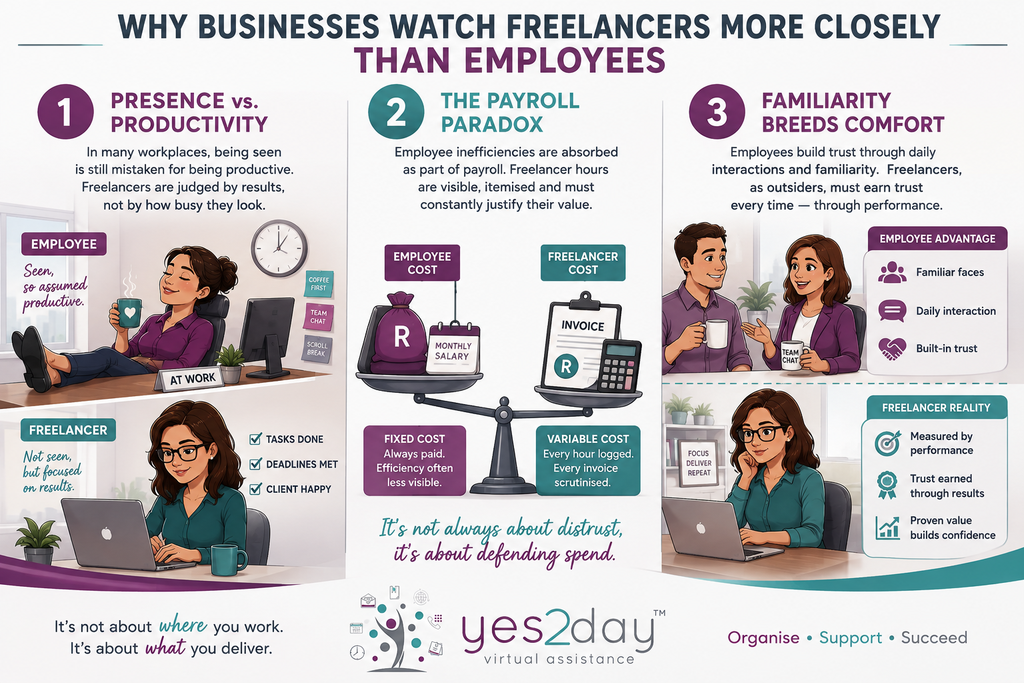
1. We Still Confuse Presence With Productivity
Traditional workplaces have taught us to associate being at work with working.
Someone arrives at 08:00, sits at their desk, attends meetings and leaves at 17:00. They’re present, so we naturally assume they’re productive.
But presence and productivity aren’t the same thing.
A freelancer changes that equation because you usually can’t see them working. There is no desk to walk past and no green Teams status to reassure you that they’re “busy”.
So what do you measure instead?
The work.
Was it completed? Was it accurate? Was it delivered on time? Did it achieve what was required?
Ironically, those are probably the questions we should be asking about everyone’s work.
2. Then There’s the Payroll Paradox
There’s another reason freelancers receive more scrutiny: their cost is highly visible.
An employee’s salary is a predictable monthly expense. Whether Tuesday was incredibly productive or half the afternoon disappeared into interruptions, the salary remains the same.
A freelancer sends an invoice.
And invoices attract attention.
Three hours of administration at a stated hourly rate looks like a specific expense that needs to be justified.
Meanwhile, three unproductive hours from a salaried employee can disappear quietly into payroll.
The cost still exists.
It’s simply less visible.
That’s the payroll paradox: businesses can become intensely focused on a visible R1,500 outsourced expense while barely noticing a much larger amount being lost through internal inefficiency.
3. Familiarity Creates Trust
Employees also have something freelancers often don’t: familiarity.
You see your employees regularly. You chat in the kitchen. You know who stayed late last week. You remember who helped when something went wrong.
That familiarity naturally builds trust.
A freelancer sits outside that environment.
They may never have met the business owner face-to-face. They aren’t part of the office conversations and their contribution is often reduced to a timesheet, project update or invoice.
So they have to prove their value differently.
Usually through results.
And while accountability is a good thing, there is an interesting question here:
Should familiarity automatically earn someone less scrutiny than measurable performance?
4. Our Management Style Hasn’t Quite Caught Up
Flexible work, outsourcing and remote work have changed how businesses operate, but many management habits haven’t changed with them.
We’re still comfortable with things we can see.
A full office feels productive.
People typing look busy.
A packed calendar looks important.
But none of those things necessarily tell us what was actually achieved.
Freelancers force businesses to manage differently because the focus shifts from:
“Were you working?”
to:
“What did you deliver?”
That can be uncomfortable because it exposes a bigger issue.
If you can’t measure someone’s performance without physically watching them work, perhaps the problem isn’t remote work or freelancing.
Perhaps the problem is how performance is being measured.
5. Freelancers Feel Like a Bigger Risk
When an employee struggles, businesses often think in terms of coaching, training or development.
When a freelancer underdelivers, the reaction can be very different:
“We’re paying for this.”
Of course you are.
But you’re paying for the employee too.
The difference is that one cost arrives neatly packaged on an invoice while the other is bundled into payroll, leave, equipment, management time and overheads.
Because outsourced costs are easier to see, businesses often try to control the perceived risk with more reporting, more check-ins, more approvals and tighter monitoring.
Some accountability is necessary.
Too much can become micromanagement — and ironically start wasting the very time you’re paying for.
6. What If We Managed Everyone By Outcomes?
This is where things get interesting.
Instead of asking why freelancers are monitored so closely, perhaps businesses should borrow something from the freelancer model.
Imagine if every role had:
- Clear responsibilities
- Defined outcomes
- Realistic deadlines
- Measurable standards
- Ownership of tasks
- Regular, purposeful check-ins
Suddenly, it matters less whether someone works from an office in Johannesburg, a home office in Cape Town or somewhere else entirely.
The question becomes:
Did the work get done — and did it create value?
That’s a far healthier measure of productivity than how long someone sat at a desk.

The Bigger Cost Isn’t the Invoice
Freelancer invoices are easy to scrutinise because they’re visible.
Lost productivity isn’t.
It hides in unnecessary meetings, duplicated work, unclear instructions, constant interruptions, poor systems, unanswered emails and tasks that take three hours when they should take one.
Those costs rarely arrive with an invoice attached.
But the business pays for them nonetheless.
And that may be the real lesson here.
Instead of scrutinising the people whose output is easiest to measure, businesses should become better at measuring productivity across the board.
From Watching the Clock to Measuring Value
This isn’t an employees-versus-freelancers debate.
It’s a productivity conversation.
Both employees and freelancers should be accountable for the work they’re responsible for. Both should have clear expectations. And both should be trusted to get on with their jobs once those expectations are understood.
South African businesses are increasingly working with a mix of permanent staff, contractors, freelancers and remote support.
That means the old question — “How many hours did you work?” — is becoming less useful.
A better question is:
“What did those hours achieve?”
Because whether someone appears on your payroll or sends you an invoice, productivity isn’t about looking busy.
It’s about getting the right things done.
Interesting Question to Ponder on
Why do companies monitor freelancers more closely than employees?
Freelancer costs are usually more visible because they appear as separate invoices or project expenses. Employee inefficiency can be harder to spot because it is absorbed into monthly payroll and normal operating costs.
Are freelancers more productive than employees?
Not necessarily. Productivity depends on the individual, the role, the systems they use and how clearly the work is managed. Freelancers are, however, often measured more directly on outputs and deliverables.
Is outsourcing cheaper than employing someone?
It depends on the work required. Outsourcing can be cost-effective when a business only needs specific skills or a limited number of hours because it pays for the support it needs rather than carrying the cost of a full-time position.
How should businesses measure productivity?
Focus on outcomes rather than visibility. Clear responsibilities, deadlines, quality standards and measurable deliverables provide a better picture of productivity than simply tracking how long someone is at their desk.
Why does micromanaging freelancers backfire?
Excessive reporting, unnecessary meetings and constant check-ins consume billable time. Clear instructions, agreed expectations and appropriate reporting usually create better accountability without adding unnecessary administration.
Final Thought
Perhaps businesses shouldn’t ask:
“How do I know my freelancer is working?”
Maybe the better question is:
“How do I know anyone in my business is productive?”
And if the only answer is because I can see them sitting at their desk, there may be a much bigger productivity problem hiding in plain sight.
#FreelancingInSouthAfrica #VirtualAssistantSA #FutureOfWork #Productivity #Outsourcing #RemoteWorkSA #SmallBusinessSouthAfrica #BusinessEfficiency #WorkSmarter
